
DESIC exists to give civil engineers more time to engineer.
After 13 years in civil engineering, I saw firsthand how much of an engineer's time gets consumed by repetitive production work — setting up sheets, framing viewports, managing references, renumbering matchlines, updating title blocks, and repeating the same steps project after project.
It's the kind of work a firm's own standards should be able to do for themselves, if only there were a way to teach a tool what those standards actually are. DESIC is that way.
DESIC was built to automate the work that software can handle, so engineers can spend more time on the work that requires engineering judgment.
If a task that used to take an afternoon can be done in minutes, the goal isn't to cram more hours into the day. It's to give the engineer time to look at the design again, work through the details, and do better engineering.
Our Mission
Our Story
DESIC was built by Keaton Scanlan, PE, a practicing civil engineer. Keaton lived the drafting grind himself — the repetitive, detail-heavy, easy-to-get-wrong production work that eats the days before every submittal — and built DESIC to eliminate it, first for his own use, then for every firm doing the same work. That background shows up in what DESIC actually does. It's not a generic AI wrapper bolted onto a CAD program. It's built by someone who knows what gets missed during plan production: that matchline references need to be renumbered too, that fields need to be refreshed before anything plots, that xrefs must be set up correctly. DESIC knows the workflow because it was built by someone doing the workflow.
Automations Powered by AI Conversation
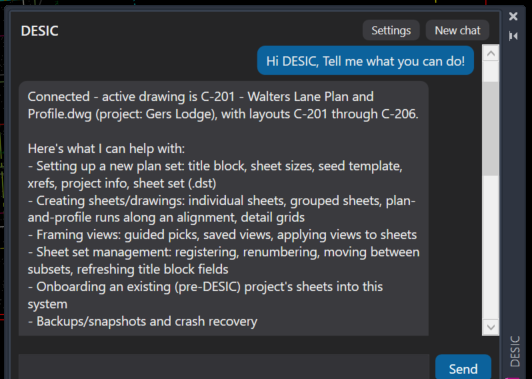
DESIC uses Claude as the conversational layer for its automations. Engineers can tell DESIC what they need and let it work through the appropriate production tasks. DESIC doesn't add new smart objects you have to learn. Everything stays simple blocks, viewports, and xrefs — nothing tied to a proprietary Civil 3D feature.
Claude provides the intelligence and conversation. DESIC provides the engineering-specific tools, workflows, project information, and automation that actually gets the work done. DESIC automates plan production. Engineers continue to make the engineering decisions.

This Is Just the Beginning
Sheet production is only the first step.
DESIC is being built around a much larger idea: civil engineering production contains far more work that can be reliably automated than the industry has traditionally treated as automatable.
The technology is finally making it possible to build tools that don't just help engineers draw faster, but actually understand enough about the workflow to perform meaningful production tasks. That's the direction DESIC is heading.
More automation. More firm-specific standards. More of the repetitive production work handled by software. And more time for engineers to do what they were trained to do.
Build better designs. Solve harder problems. Spend less of their careers doing tasks.